
"Remember not to forget": A 9/11 commemoration
Hannah Moelker- Staff Reporter
Geneva College- Flickr
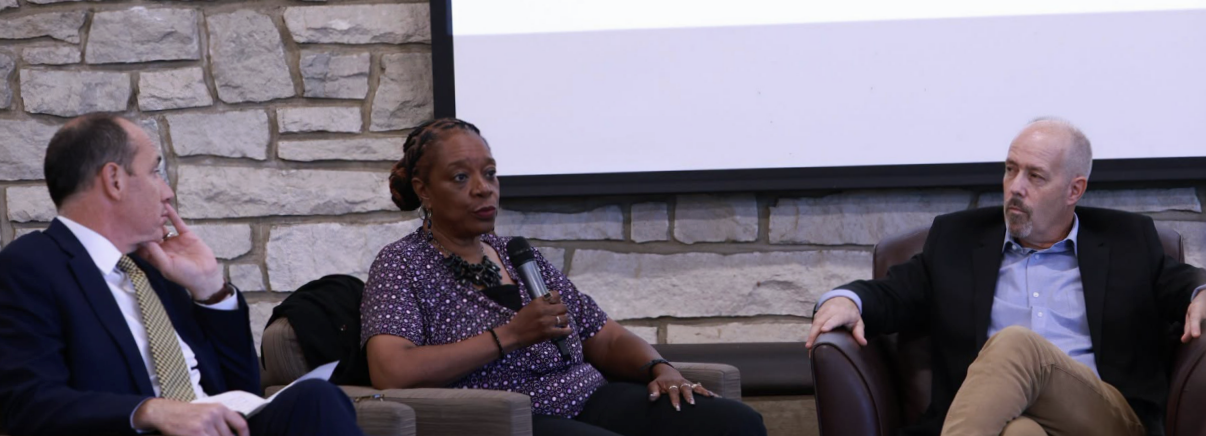
On Friday Sept 11, students and faculty gathered in Skye Lounge for an inaugural Dialogue Wheel titled, "A Commemorative Conversation About 9/11." Hosted by Dr. Jim Spiegel from Geneva's Center for Faith and Life (CFL), the event featured the CFL's first cohort of Faculty Fellows discussing their personal experiences of 9/11.
"Every generation has a defining moment," said Dr. Spiegel as he opened the event. For some, it may have been Pearl Harbor or the assassination of JFK. Dr. Spiegel said 9/11 was one of these moments, and it is hard to convey this to those who did not live through it, like most current Geneva students. According to Dr. Spiegel, the 9/11 Dialogue Wheel's purpose was twofold—to educate, and to commemorate 9/11.
After President Calvin Troup prayed, the audience watched a short video recapping the events of 9/11. Then the Fellows—Dr. Henrique Alvim, Dr. Matt Fuss, Dr. Mildred Johnson and Dr. Joel Ward—took their seats in front of the audience. Dr. Spiegel prompted the discussion with three questions which the Fellows had been given in advance. Each Fellow was given five minutes to respond per question. The following are highlights of some of their responses.
Where were you when 9/11 happened?
Dr. Johnson and Dr. Fuss were both working in Pittsburgh, Dr. Alvim was teaching in Brazil, and Dr. Ward was working in Bangladesh.
Dr. Fuss said he was a young professional in Pittsburgh. For him, it was "just another day." Someone came in and asked, "Did you see what happened?" Then, Dr. Fuss and his coworkers found an old TV on a wheel cart in a conference room, jerry-rigged an antenna and tuned in to the local news station. They heard that another plane may have been heading to Pittsburgh, which caused lots of panic. Dr. Fuss recalled going back to his office, gobsmacked and kneeling at his desk to pray.
Similarly, Dr. Johnson was getting ready to work as a community-oriented police sergeant in Pittsburgh at the time of the attacks. She recalled being called in to reroute traffic and come into the zone with full gear. There was total chaos at the police station, and everything was falling apart. She said, "I immediately had to readjust everything and put on my chaplain hat... The Lord gave me strength, and I started praying with everybody."
Dr. Ward was out of the country, working as a community development researcher in Bangladesh for the Mennonite Central Committee. On 9/11, he was working with farmers in the jungle, with no access to technology. On 9/12, Dr. Ward entered the main headquarters of his work, where people greeted him and offered condolences, but Dr. Ward did not know what they were talking about. Someone found a newspaper and showed him a picture of the World Trade Center.
"Many of the people offering condolences to me were my Muslim friends and colleagues," Dr. Ward said. "Many who were grieved by the event were my Muslim friends, because they loved the United States."
How did 9/11 change you? What did you learn about yourself and this world from 9/11?
For Dr. Fuss, it "personally and nationally burst the bubble that we were unassailable." However, it also was extremely unifying. Dr. Fuss said that he learned, "We need more 9/12s."
Dr. Johnson shared that 9/11 changed her life completely and taught her to depend on the Lord Jesus Christ. She had just had a baby and was struggling with postpartum depression when her husband, who was in the military, got a voicemail that said, "You have been activated. Report for duty at 5 am Monday morning." He was deployed for one year. During this time, she hit "rock bottom." She said she shares all this "so others know that God is faithful, and He will bring you through."
9/11 impacted Dr. Alvim immediately. Only five months into their marriage, Dr. Alvim's wife was deployed to Iraq for nine months. It was very clear to him that she might not come home, and he considered it a small win every day someone did not knock on the door.
Dr. Alvim also learned how much fear and forgetfulness is part of the human experience. He discussed the security measures taken in airports after 9/11, saying we often forget the cause of it. He reminded the audience that X-rays did not protect them, though, and quoted Psalm 121: "My help comes from the Lord, who made heaven and earth." Five times in that Psalm, it says that God is our Keeper. While he is thankful for created things, Dr. Alvim said he is thankful for the foundation of our safety, which is the Lord Himself.
How did 9/11 impact your thinking about the sovereignty of God?
Dr. Johnson said that 9/11 showed her that God is in control, and "He can take ashes and make beauty." Dr. Fuss added that he learned that you have to purposefully, daily make the choice to believe in the promises of God, which are true; and that His mercies renew every day.
Dr. Ward spent 12 months in Bangladesh, and witnessed much suffering. It was easy to be overwhelmed and have feelings of helplessness. Instead, one has to decide to trust God, and believe the things He says about Himself.
Looking back, Dr. Alvim saw many markers of the goodness and sovereignty of God. Any number of things could have happened, but "God is good, He was there, and He was the one who sustained our lives."
Most undergraduate students at Geneva were not born on September 11, 2001, and can only learn more about the attacks from the experience of others. Dr. Alvim encouraged people to make it a habit to "remember not to forget." This Dialogue Wheel was an exercise in exactly that, as many commemorated 9/11 through the impact it had on four lives.
HANNAH MOELKER
